

What Causes Hypnagogic Hallucinations?
Hallucinations, especially hypnopompic and hypnagogic ones, usually happen when you are waking up or falling asleep, not during a specific stage of sleep. Such hallucinations are not usually cause for concern; however, if they are disruptive to an individual’s sleep cycle or accompanied by additional sleep-related symptoms, consulting a sleep expert is the best course of action. Our team at Koala Center for Sleep Disorders will help you with it. For more information, please contact us or book an appointment online now! We are conveniently located at 2309 E. Empire St. Ste 500 Bloomington, IL 61704.
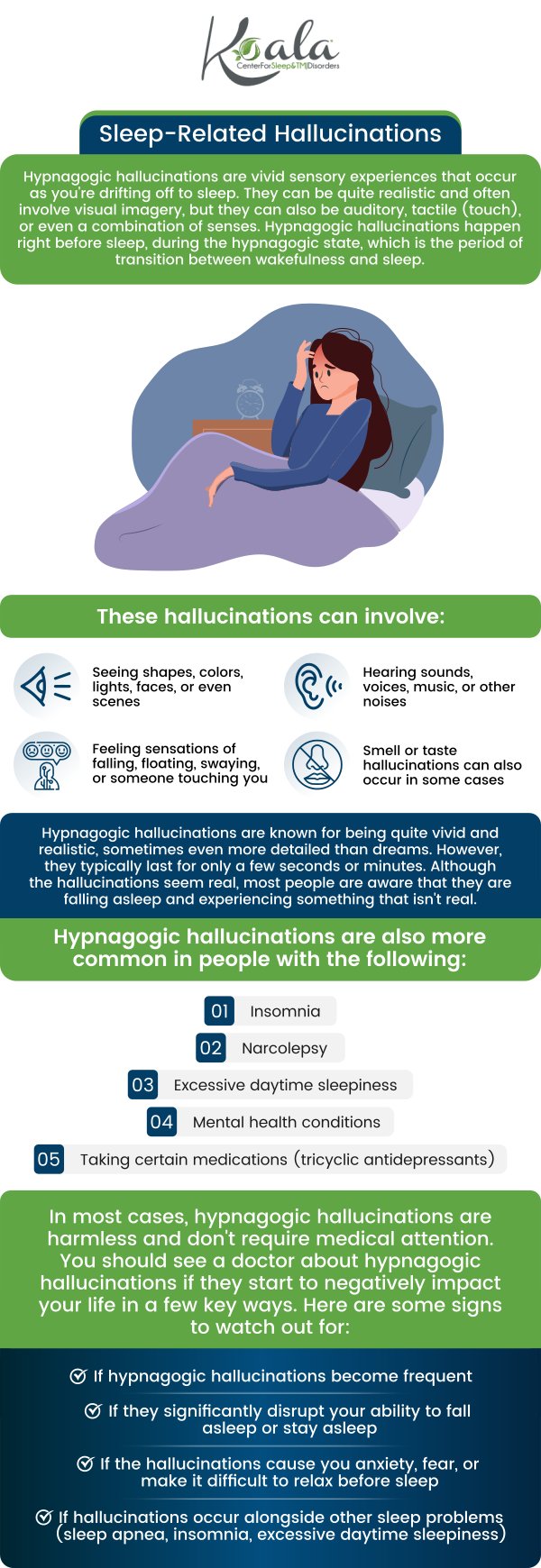
Table of Contents:
How rare are hypnopompic hallucinations?
In what stage of sleep do most hallucinations occur?
How long do sleep hallucinations last?
What are the most common visual hallucinations?
Insights from Our Team at Koala Center for Sleep Disorders On What Causes Hypnagogic Hallucinations
Hypnopompic hallucinations are a specific type of hallucination experienced by individuals as they wake up in the morning. These hallucinations are sensory experiences that differ from reality in any number of ways, potentially involving auditory, visual, tactile, or olfactory perceptions that are not present.
Hypnopompic hallucinations share similarities with general hallucinations in terms of their symptomatic presentation but are distinct because they occur during the transition from sleep to wakefulness. This state blurs the lines between dreaming and full consciousness, making it a unique period of brain activity.
Hypnopompic hallucinations are fairly common, with more than 10% of people experiencing them at some point. Hypnagogic hallucinations, which occur as individuals fall asleep, are even more common, affecting upwards of 35% of individuals. Together, these experiences are encompassed under the broader term hypnagogia, which describes different types of hallucinations that can occur during different parts of sleep transitions.
Hallucinations, particularly those of the hypnopompic and hypnagogic varieties, typically occur during the transitions between sleep and wakefulness rather than within a specific stage of sleep.
These experiences are most closely linked to the hypnagogic state, which includes both falling asleep (hypnagogic hallucinations) and waking up (hypnopompic hallucinations). This contrasts with other sleep phenomena, such as nightmares, which typically occur during the rapid eye movement (REM) stage of sleep, when an individual is fully immersed in sleep.
Hallucinations during these transitional phases are indicative of the brain’s complex activity as it moves between different states of consciousness. They can occasionally accompany sleep paralysis, where the individual’s awareness of the inability to move adds a layer of intensity to the experience.
The duration of sleep hallucinations, including both hypnopompic and hypnagogic experiences, is generally brief, spanning only a few seconds to several minutes. However, different individuals will experience them differently.
These hallucinations occur as transient phenomena that bridge the gap between wakefulness and the dream state, reflecting the rapid transition of brain activity during these periods. Due to their occurrence during these brief periods, sleep hallucinations are inherently short-lived. While the exact duration can vary based on individual factors and the specific context of the hallucination, it is uncommon for them to persist for an extended period.
In some instances, especially when accompanied by sleep paralysis, the hallucinations may last longer due to the added layer of being semi-conscious yet unable to move. However, the inherent nature of these experiences as brief and transient remains consistent, which makes them different from the more extended experiences found in dreams.
Visual hallucinations are among the most frequently reported types during hypnopompic and hypnagogic states, with individuals commonly experiencing a range of visual distortions that do not correspond to actual experiences. These most commonly include simple visual phenomena such as flashing lights, shapes, or patterns.
However, they can also be associated with more complex and detailed images like faces, animals, or entire scenes. The vividness and complexity of these hallucinations can vary widely, but they share the characteristic of being brief and fleeting.
Unlike dreams, which can develop extended narratives and involve longer sequences of events, these hallucinations are more akin to brief flashes or moments of visual perception that quickly pass. Such visual hallucinations are not usually cause for concern. However, consulting a sleep expert is the best course of action if they are disruptive to an individual’s sleep cycle or accompanied by additional sleep-related symptoms.
Sleep hallucination treatment is available at the Koala® Center For Sleep & TMJ Disorders.
Hypnagogic hallucinations, the vivid experiences that occur as you fall asleep, can be caused by various factors. At Koala Center for Sleep Disorders in Bloomington, IL, our professional team understands that these hallucinations can be unsettling, and we are here to help you understand what triggers them.
What Causes Hypnagogic Hallucinations?
● Sleep Deprivation: One of the most common causes of hypnagogic hallucinations is a lack of sleep. When the brain is deprived of restful sleep, it can enter REM sleep prematurely, leading to vivid dreams or hallucinations.
● Irregular Sleep Patterns: Disrupted or inconsistent sleep schedules can confuse your brain, increasing the likelihood of experiencing hypnagogic hallucinations.
● Stress and Anxiety: High levels of stress or anxiety can trigger heightened brain activity during sleep onset, causing the brain to misfire and produce vivid imagery or sounds.
● Sleep Disorders: Conditions like narcolepsy or sleep apnea, which affect the quality of sleep, may also lead to these types of hallucinations.
Our team at Koala Center for Sleep Disorders works closely with you to identify the root cause of your sleep issues. By understanding and treating these causes, we can help you achieve a more restful, peaceful night’s sleep. Reach out to us for personalized solutions and expert care. For more information, please contact us or book an appointment online now! We are conveniently located at 2309 E. Empire St. Ste 500 Bloomington, IL 61704.

Additional Services You May Need
▸ KoalaKIDZzz®
▸ Sleep Apnea
▸ Snoring
▸ TMJ Disorder
▸ Fatigue
▸ Sleep Disorders
▸ Weight Loss
▸ CPAP Alternative
▸ Oral Appliances


 Send Text
 How May I Help You?