

How Can I Stop My Snoring in El Paso, TX?
Snoring can be more than an annoying nighttime sound. It can interrupt your sleep, affect your partner’s rest, and sometimes point to an underlying sleep disorder, such as obstructive sleep apnea (OSA). If you regularly snore, wake up feeling tired, or experience nighttime choking or gasping, it may be time to find out what is causing the problem. At Koala® Center For Sleep & TMJ Disorders in El Paso, TX, we help patients address snoring and related sleep concerns through personalized care. Our team offers oral appliance therapy, a non-surgical treatment option that can help reduce snoring and support better airflow during sleep. We also evaluate concerns related to sleep apnea and other sleep disorders. The right solution depends on why you snore. Whether your snoring is related to sleeping position, airway narrowing, or obstructive sleep apnea, understanding the cause is the first step toward quieter, healthier nights. For more information, contact us or book an appointment online. We are conveniently located at 6901 Helen of Troy, Ste D-2 El Paso, TX 79911.
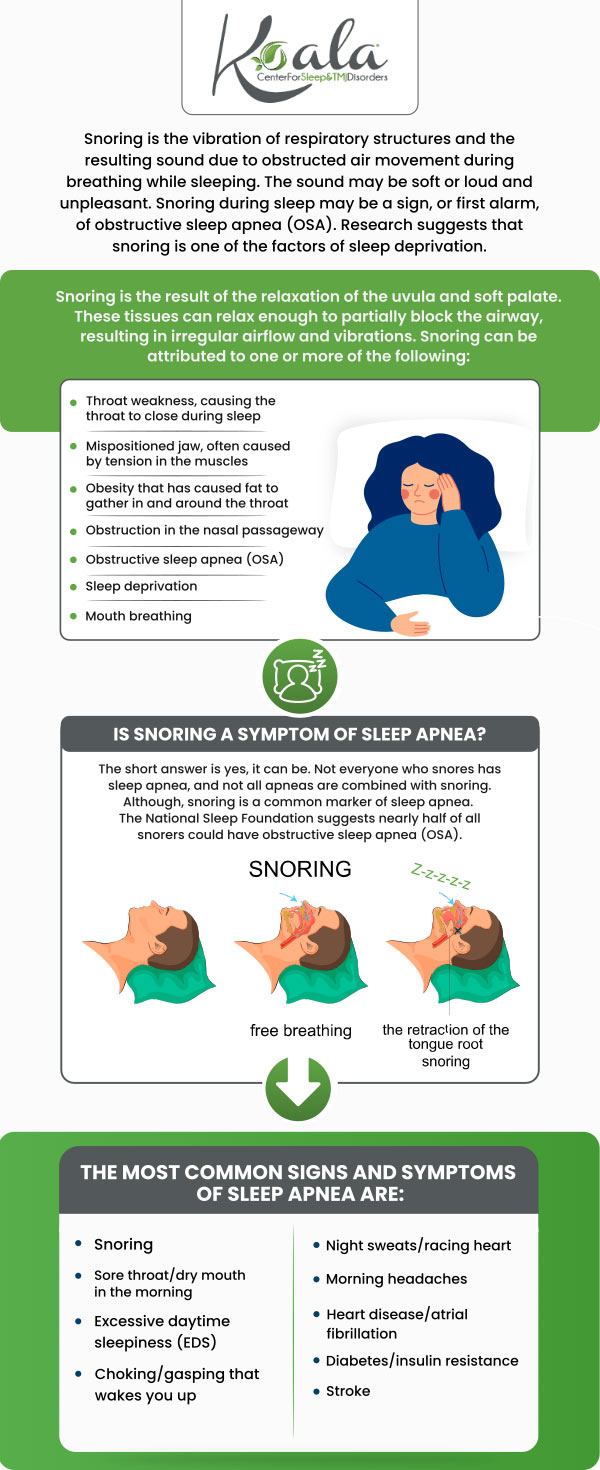
Table of Contents:
How can I stop my snoring?
Can an Oral Appliance Stop Snoring?
When Should You Seek Professional Snoring Treatment?
How Do You Sleep With a Snorer?
How Do I Know What Kind of Snorer I Am?
How Can You Identify Your Snoring Pattern?
Get Help for Snoring at Koala® Center For Sleep & TMJ Disorders in El Paso, TX
Frequently Asked Questions About How to Stop Snoring
Medical References and Supporting Sources
You can reduce snoring by identifying what causes it and choosing the right treatment. Snoring happens when air moves through a narrowed airway during sleep, causing the surrounding tissues in your throat to vibrate.
Several factors can contribute to snoring, including:
• Sleeping on your back: Your tongue and soft tissues may move toward the back of your throat, narrowing the airway.
• Excess body weight: Extra tissue around the neck can put pressure on the airway.
• Alcohol consumption: Alcohol relaxes the muscles in your throat, which can make snoring worse.
• Nasal congestion: Allergies, colds, or other nasal problems can make breathing through your nose more difficult.
• Airway structure: The shape of your jaw, tongue, throat, or soft palate may affect airflow during sleep.
• Obstructive sleep apnea: Repeated airway blockages during sleep can cause loud snoring, gasping, and breathing pauses.
Ways to Reduce Snoring Naturally
If you have occasional or mild snoring, certain lifestyle changes may help:
1. Sleep on your side
Sleeping on your back can allow your tongue and soft tissues to fall toward the back of your throat. Side sleeping may help keep your airway more open and reduce snoring.
2. Maintain a healthy weight
If you are overweight, losing weight may reduce excess tissue around your neck and throat. This can help improve airflow during sleep.
3. Avoid alcohol before bedtime
Alcohol relaxes the muscles that support your airway. Avoiding alcohol, especially close to bedtime, may help reduce nighttime snoring.
4. Address nasal congestion
Allergies and nasal congestion can make breathing difficult. Treating the underlying congestion may help improve airflow. Nasal strips may also help some people with nasal obstruction, but they do not treat obstructive sleep apnea.
5. Maintain a consistent sleep schedule
Getting enough sleep and following a regular bedtime routine may help reduce sleep-related problems. Sleep deprivation can also contribute to increased snoring in some people.
These steps may help with simple snoring, but they are not a substitute for medical evaluation if you have signs of sleep apnea.
Yes. Oral appliance therapy is a non-surgical treatment that can help reduce snoring by improving airflow through the upper airway.
At Koala® Center For Sleep & TMJ Disorders, we offer oral appliance therapy for patients who need an alternative to traditional CPAP treatment or who may benefit from a custom-fitted dental device.
An oral appliance is worn during sleep. It gently moves the lower jaw and, depending on the device, helps position the tongue forward to reduce airway narrowing. This can decrease the vibrations that cause snoring.
Oral appliance therapy may be appropriate for:
• Adults with primary snoring who do not have obstructive sleep apnea.
• Patients with mild to moderate obstructive sleep apnea who prefer an alternative to CPAP.
• Certain patients with more severe sleep apnea who cannot tolerate CPAP or are not suitable candidates for it.
• The device must be properly selected, fitted, and adjusted. Treatment also requires follow-up to check its effectiveness and monitor dental health and bite changes.
A sleep physician should evaluate patients for sleep apnea before oral appliance treatment is prescribed. A follow-up sleep study may also be needed to confirm that the appliance is working.
Occasional snoring may not be a major concern. However, persistent or loud snoring deserves attention, especially when it occurs with other symptoms.
Consider a professional evaluation if you:
• Snore loudly on most nights.
• Wake up choking, gasping, or short of breath.
• Have been told that you stop breathing during sleep.
• Experience morning headaches or dry mouth.
• Feel excessively tired during the day.
• Have trouble concentrating or staying alert.
These symptoms may indicate obstructive sleep apnea. A sleep evaluation and appropriate testing can help determine whether you have this condition and how it should be treated.
At our El Paso sleep clinic, Dr. Bryan Kalish, DDS, MS, D.ABDSM, has advanced training in treating snoring and sleep apnea with oral appliances. His background in periodontics and dental sleep medicine allows him to address dental and oral health factors involved in this type of treatment.
Our goal is to help you understand your snoring and explore appropriate treatment options for better sleep.
Sleeping next to someone who snores can be frustrating, especially when the noise wakes you up several times throughout the night. Over time, interrupted sleep can affect your mood, energy, concentration, and overall well-being.
Fortunately, there are ways to make sleeping with a snorer easier while encouraging them to address the underlying problem.
Here are some practical tips:
1. Encourage side sleeping
If your partner snores mainly while sleeping on their back, gently encourage them to sleep on their side. Changing sleeping positions may reduce airway narrowing and make snoring less noticeable.
2. Try earplugs or white noise
Comfortable earplugs or a white noise machine may help mask some of the noise. These are temporary ways to protect your own sleep, not treatments for your partner’s snoring.
3. Keep a consistent sleep schedule
Going to bed and waking up at regular times can help improve your sleep quality. If your partner snores, maintaining healthy sleep habits may help you manage nighttime disruptions.
4. Discuss the problem calmly
Snoring is not usually something a person can control while asleep. Instead of treating it as a habit or a personal annoyance, discuss how it affects both of you. Encourage your partner to seek an evaluation if the snoring is frequent or loud.
5. Encourage professional evaluation
Persistent snoring may be associated with obstructive sleep apnea. If your partner stops breathing, gasps, or chokes during sleep, encourage them to speak with a healthcare professional.
At Koala® Center For Sleep & TMJ Disorders, we understand that snoring affects more than one person. Our oral appliance therapy may help suitable patients reduce snoring and improve sleep for themselves and their bed partners.
Treating the underlying cause can be more helpful than relying on temporary solutions.
Not all snoring is the same. The sound, frequency, sleeping position, and other symptoms can provide clues about what may be causing your snoring.
However, there is no reliable way to diagnose the type or cause of snoring based on sound alone. A professional evaluation may be needed to determine whether your snoring is harmless or related to a sleep disorder.
Here are some common snoring patterns:
1. Nose Snoring
Nasal snoring happens when airflow through the nose is restricted. Allergies, a stuffy nose, a deviated septum, or other nasal problems may contribute to this type of snoring. People with nasal snoring may notice that they have difficulty breathing through their nose, particularly when lying down. Addressing nasal congestion or an underlying nasal condition may help improve airflow.
2. Mouth Snoring
Mouth snoring occurs when a person breathes through their mouth during sleep. This may happen because of nasal congestion, relaxed throat tissues, or other airway-related factors. People who snore through their mouths may also wake up with a dry mouth or sore throat. The cause should be identified before choosing a treatment.
3. Tongue-Based Snoring
When you fall asleep, the muscles in your tongue and throat naturally relax. In some people, the tongue moves backward and reduces the space available for airflow. As air passes through the narrowed space, surrounding tissues may vibrate and produce snoring sounds. A properly fitted oral appliance may help some patients by gently positioning the lower jaw and tongue to improve airway space.
4. Positional Snoring
Some people snore mainly when sleeping on their backs. This happens because gravity can cause the tongue and soft tissues to move toward the back of the throat. Changing to a side-sleeping position may help reduce this type of snoring. However, positional snoring can also occur in people with obstructive sleep apnea, so changing positions alone may not be enough.
5. Sleep Apnea-Related Snoring
This is an important type of snoring to recognize. Obstructive sleep apnea occurs when the upper airway repeatedly becomes partially or completely blocked during sleep. Common warning signs include:
• Loud, frequent snoring.
• Pauses in breathing noticed by a bed partner.
• Gasping, choking, or snorting during sleep.
• Morning headaches.
• Excessive daytime sleepiness.
• Difficulty concentrating.
Not everyone who snores has sleep apnea, and some people with sleep apnea do not snore. A sleep study is often needed to confirm the diagnosis.
You can start by paying attention to when and how you snore.
Ask your bed partner whether you snore more when sleeping on your back, whether the sound seems to come from your nose or mouth, and whether they notice breathing pauses.
You may also record your snoring sounds to share with your healthcare provider. However, recordings and smartphone applications cannot diagnose sleep apnea.
At Koala® Center For Sleep & TMJ Disorders in El Paso, TX, we focus on evaluating snoring and related sleep concerns. Dr. Bryan Kalish has advanced training in dental sleep medicine and oral appliance treatment for snoring and sleep apnea.
An appropriate evaluation can help determine whether oral appliance therapy or another treatment approach may be right for you.
You do not have to accept loud snoring and disrupted sleep as a normal part of life. Finding out why you snore can help you choose a treatment that supports healthier breathing and more restful nights.
At Koala® Center For Sleep & TMJ Disorders in El Paso, TX, our team provides care for snoring, sleep apnea, TMJ disorders, and related concerns. We offer oral appliance therapy as a non-surgical treatment option for appropriate patients who want to reduce snoring or explore an alternative to CPAP. Dr. Bryan Kalish, DDS, MS, D.ABDSM, has advanced training in dental sleep medicine, orofacial pain, and oral appliance treatment. He works with patients to address sleep-related concerns through individualized care.
If snoring is affecting your sleep or your relationship with your bed partner, we encourage you to take the next step.
Contact Koala® Center For Sleep & TMJ Disorders today to schedule an appointment and learn more about snoring treatment in El Paso, TX.
1. What is the fastest way to stop snoring?
Sleeping on your side, avoiding alcohol before bedtime, and addressing nasal congestion may help reduce snoring. However, the best solution depends on its underlying cause.
2. Can snoring be cured permanently?
Snoring can sometimes be eliminated or significantly reduced by treating its underlying cause. Results vary, and some people need ongoing treatment or lifestyle changes to manage it.
3. Does sleeping with your mouth open cause snoring?
Mouth breathing can contribute to snoring, especially when nasal congestion or airway narrowing is present. Identifying why you breathe through your mouth can help determine the right treatment.
4. Can an oral appliance stop snoring?
Yes. A custom oral appliance can help reduce snoring by repositioning the lower jaw and supporting better airflow. It should be prescribed and monitored by qualified professionals after appropriate evaluation.
5. Is snoring a sign of sleep apnea?
Not always. However, loud snoring combined with breathing pauses, choking, gasping, or daytime sleepiness may indicate obstructive sleep apnea. A sleep evaluation can help confirm the diagnosis.
6. When should I see a doctor about snoring?
Seek an evaluation if your snoring is frequent, loud, or accompanied by breathing pauses, morning headaches, or excessive daytime tiredness. Early evaluation can help identify sleep apnea and other potential causes.
1. National Heart, Lung, and Blood Institute (NIH) – Sleep Apnea Symptoms
Sleep apnea symptoms and warning signs.
2. National Heart, Lung, and Blood Institute (NIH) – Sleep Apnea Diagnosis
Sleep studies and diagnosis of sleep apnea.
3. American Academy of Sleep Medicine – Oral Appliance Therapy Clinical Practice Guideline
Clinical practice guideline for oral appliance treatment of obstructive sleep apnea and snoring.
4. American Academy of Dental Sleep Medicine – Obstructive Sleep Apnea and Snoring
Understanding diagnosis and treatment options.

Additional Services You May Need
▸ KoalaKIDZzz®
▸ Sleep Apnea
▸ Snoring
▸ TMJ Disorder
▸ Fatigue
▸ Sleep Disorders
▸ Weight Loss
▸ CPAP Alternative
▸ Oral Appliances


 Send Text
 How May I Help You?